Wednesday, May 25, 2016

Know our Overseas Filipinos

Posted by Belarmino Dabalos Saguing
Rome, Italy May 25, 2015


Definitions 

An Overseas Filipino   is a person of Filipino origin who lives outside of thePhilippines. This term applies to Filipinos who are abroad indefinitely as citizens or as permanent residents of a different country and to those Filipino citizens abroad for a limited, definite period, such as on a work contract or as students. It can also include seamen and others who work outside the Philippines but are neither permanent nor temporary residents of another country. As a result of this migration, many countries have substantial Filipino communities.
Overseas Filipinos are known by a variety of terms with slightly different and sometimes overlapping meanings.Overseas Contract Workers, also known as OCWs, are Filipinos working abroad that are expected to return permanently either upon the expiration of a work contract or upon retirement. Balikbayans are Filipinos who have become citizens of another country and have returned to the Philippines for temporary visits. Global Filipino is a term of more recent vintage that is less widely used. Overseas Filipino Investor or OFIs are those Filipino expatriates who contribute to the economy through remittances, buying properties and creating businesses. This was coined by Gloria Macapagal-Arroyo, the 14th President of the Philippines.

Population
In 2013, the Commission on Filipinos Overseas (CFO) estimated that approximately 10.2 million Filipinos worked or resided abroad.[1] In the census year of 2010, about 9.3 percent of Filipinos worked or resided abroad.
More than a million Filipinos every year leave to work abroad through overseas employment agencies, and other programs, including government-sponsored initiatives. Overseas Filipinos often work as doctors, physical therapists, nurses, accountants, IT professionals, engineers, architects, entertainers, technicians, teachers, military servicemen, seafarers, students and fast food workers. Also, many overseas workers are women applying as domestic helpers and caregivers. Others emigrate and become permanent residents of other countries.
The exodus includes a number of skilled workers taking on unskilled work overseas, resulting in what has been referred to as a brain drain, affecting the health and education sectors. For example, doctors have retrained to become nurses.

Economic impact
In 2012, the Bangko Sentral ng Pilipinas (BSP), the central bank of the Philippines, expects official remittances coursed through banks and agents to grow 5% over 2011 to US$21 billion, but official remittances are only a fraction of all remittances. Remittances by unofficial, including illegal, channels are estimated by the Asian Bankers Association to be 30 to 40% higher than the official BSP figure. In 2011, remittances were US$20.117 billion.
Philippines is the fourth largest recipient of official remittances after ChinaIndia, and Mexico. OFW remittances represent 13.5% of the country's GDP, the largest in proportion to the domestic economy among the four countries. OFW remittances is also credited for the Philippines' recent economic growth resulting to investment status upgrades from credit ratings agencies such as Fitch and S&P.
In 2012, approximately 80% of the remittances came from only 7 countries—United States and Canada, the United Kingdom, UAE and Saudi Arabia, Singapore, and Japan.


Contributions

Employment conditions
Employment conditions abroad are relevant to the individual worker and their families as well as for the sending country and its economic growth and well being. Poor working conditions for Filipinos hired abroad include long hours, low wages and few chances to visit family. Women often face disadvantages in their employment conditions as they tend to work in the elder/child care and domestic. These occupations are considered low skilled and require little education and training, thereby regularly facing poor working conditions. Women facing just working conditions are more likely to provide their children with adequate nutrition, better education and sufficient health. There is a strong correlation between women's rights and the overall well being of children. It is therefore a central question to promote women's rights in order to promote children's capabilities.

Government policy
Philippine Labor Migration Policy has historically focused on removing barriers for migrant workers to increase accessibility for employment abroad. Working conditions among Filipinos employed abroad varies depending on whether the host country acknowledges and enforces International labor standards. The standards are set by the ILO, which is an UN agency that 185 of the 193 UN members are part of. Labor standards vary greatly depending on host country regulations and enforcement. One of the main reasons for the large differences in labor standards is due to the fact that ILO only can register complaints and not impose sanctions on governments.
Emigration policies tend to differ within countries depending on if the occupation is mainly dominated by men or women. Occupations dominated by men tend to be driven by economic incentives whereas emigration policies aimed at women traditional tend to be value driven, adhering to traditional family roles that favors men's wage work. As women regularly are seen as symbols of national pride and dignity governments tend to have more protective policies in sectors dominated by women. These policies risk to increase gender inequality in the Philippines and thereby this public policy work against women joining the workforce.[
The Philippine government has recently opened up their public policy to promote women working abroad since the world's demand for domestic workers and healthcare workers has increased. This has led to the government reporting a recent increase in women emigrating from the Philippines. A healthcare problem arises as migrating women from the Philippines and other developing countries often create a nursing shortage in the home country. Nurse to patient ratio is down to 1 nurse to between 40 and 60 patients, in the 1990s the ratio was 1 nurse to between 15 and 20 patients. It seems inevitable that the healthcare sector losses experienced nurses as the emigration is increasing. The Japan-Philippines Economic Partnership Agreement is seen as a failure by most since only 7% of applicants or 200 nurses a year has been accepted on average. Mainly due to resistance by domestic stakeholders and failed program implementation. The result is a "lose-lose" outcome where Philippine workers fail to leverage their skills and a worldwide shortage persists.Despite the fact that Japan has an aging population and many Filipinos want to work in Japan a solution has not yet been found. The Japanese Nursing Association supports "equal or better" working conditions and salaries for Filipino nurses. Yagi propose more flexible wages to make Filipinos more attractive on the Japanese job market.
Results from a focus group in the Philippines shows that the positive impacts from migration of nurses is attributed to the individual migrant and his/her family, while the negative impacts are attributed to the Filipino healthcare system and society in general. In order to fill the nursing shortage in the Philippines suggestions that OFWs return to train local nurses has been made by several NGO’s and training will be needed in order for the Philippines to make up for all nurses migrating abroad.

Host country policies
Wealthier households derive a larger share of their income from abroad. This might suggest that government policies in host countries favor capital-intensive activities. Even though work migration is mainly a low and middle class activity the high-income households are able to derive a larger share of their income from abroad due to favorable investment policies. Despite work migration being dominated by workers from low and middle income households it is still wealthier households that derive the largest portion of their income from abroad. These favorable investment policy's causes an increase in income inequalities and does not promote domestic investments that can lead to increased standard of living. This inequality threatens to halt the economic development as investments are needed in the Philippines and not abroad in order to increase growth and well-being. A correlation between successful contribution to the home country's economy and amounted total savings upon the migrants return has been found, therefore it is important to decrease income inequalities while attracting capital from abroad to the Philippines.
Many host governments of OFWs have protective policies and barriers making it difficult to enter the job market. Japan has been known for rigorous testing of Filipinos in a way that make them look reluctant to hold up their part of the Japan-Philippines Economic Partnership Agreement and solely enjoy the benefit of affordable manufacturing in the Philippines, not accepting and educating OFWs.

Unions and advocacy groups


Filipino migrant workers in Hong Kong.
Multiple NGOs such as UNIFEMUNESCO and Institute for Global Labour and Human Rights are actively working to improve employment conditions globally. The ILO is a UN agency that deals with unfair working conditions and promote decent work for all no matter if it is domestically or abroad. Established in 1981 the Mission for Migrant Workers (MFMW) is the longest existing independent service provider for migrants in Asia.  By providing legal help, counseling, and a place to meet the MFMW helps migrant workers in Hong Kong.
International migration will not become perfectly mobile as long as autonomous countries create barriers to entry. These barriers are normally applied on certain sectors or restrictions aimed at workers from specific countries or regions. The WTOis an organization that works to decrease restrictions worldwide and promote free trade. The WTO has divided the masses of emigrating workers as some promote fair working conditions and strong labor rights. This group of workers argue that removal of international barriers and restrictions will enable equality and free choice no matter where you work or live. Others criticize the WTO for creating a dual international labor market that favors those with highly skilled jobs while low skilled jobs are highly immobile due to public policy and often faces restricted international movement as a result. The restrictions vary depending on level of education, host country and home country.

Family
Work migration is increasing on a global scale and especially among women; it is especially sectors such as care and domestic work that have seen a rapid increase of women emigrating. The Philippines is leading this development but it is worrisome that as many as 60% of OFWs are temporary workers. Temporary jobs tend to be excluded from basic labor rights such as overtime pay, regular breaks or restricted working hours. Temporary workers can easily be fired and replaced which is the major reason foreign firms often prefer migrant workers. This temporariness causes an additional stress for the family. Many children of migrant workers has grown up not knowing both of their parents. Many children of longterm absent parents does not feel affection towards them, or might not even recognize them. Many relationships are broken as one parent emigrates which causes a larger proportion of children growing up with divorced or unhappy parents. "In the case of the Philippines, Sri Lanka and Indonesia, the strategy is predicted on calling upon women to take the lead in the development agenda, engendering responsibility for generating the means to fund investments in this development".
Remittances are money that are sent home from abroad by the migrant worker. These remittances earned by overseas Filipinos are indisputably positive for individual families and the governments balance of payments as well as the GDP. However it has been found that remittances are primarily used for costs of living such us food and education. Remittances fill the function of covering short term costs but wages are not sufficient to enable savings and investments. It has yet to be proven that remittances can be translated into value adding activities such as start-ups and investments. For the economy to thrive it is fundamental that the value adding activities are creating a long-term sustainable growth in order to improve healthcare, education, infrastructure and government programs.
Migration is often explained through push and pull factors with remittances pulling skilled workers from the Philippines to move abroad if they are well educated and want better pay in order to escape poverty and help the family. However, push and pull factors rarely include social stigmas, family expectations, gender roles or personal preferences. Leaving the family behind can become a burden for many educated women or men whose parents, partner and extended family expect them to work abroad.
There is some evidence that women migrating from the Philippines send back more money in relative and sometimes absolute terms than the Filipino men. This is often explained by the women’s great commitment to the family and good abilities to save income. The Philippines government has recognized this recent trend and has therefore targeted sectors traditionally employing women such as childcare, domestic work, healthcare, service jobs and eldercare.
It has been emphasized by the World Bank that the Philippines has the largest portion of remittances in relation to GDP in the world. It is pointed out that remittances alone cannot keep the Philippines economy afloat and sustainable long term growth must come from domestic investment and growth
There is some evidence that women in so-called "major sending countries" (e.g. Philippines and Sri Lanka) have higher autonomy and decision-making power within their households than those in "non-sending countries". This suggests that women to a larger extent are making economic decisions in the household. More than economic decisions ought to be measured until conclusions can be drawn from positive or negative effects of more women migrating for wage work and its impact on the family. However, this recent trend will empower women while broadening views and hopefully engage workers in defending their rights.Philippines.".

Return migration
Returning migrant workers are often argued to have a positive effect on the home economy since they are assumed to gain skills and return with a new perspective.Deskilling has caused many Filipino workers to return less skilled after being assigned simple tasks abroad, this behavior creates discouragement for foreign workers to climb the occupational ladder. Deskilling of labor is especially prevalent among women who often have few and low skill employment options, such as domestic work and child or elder care. Other occupations that recently has seen an increase in deskilling are doctors, teachers and assembly line workers.
To underline what a common problem this deskilling is returning migrant workers are calling for returnee integration programs, which suggests that they do not feel prepared to be re integrated in the domestic workforce.
As the Philippines among other countries who train and export labor repeatedly has faced failures in protecting labor rights the deskilling of labor has increased on a global scale. A strong worldwide demand for healthcare workers causes many Filipinos to emigrate without ever getting hired or become deskilling while possibly raising their salary. The result is a no-win situation for the sending and receiving country. The receiving countries lose as skilled workers are not fully utilizing their skills while the home country simultaneously experience a shortage of workers in emigrating prone sectors.

Countries with Filipino populations


Lucky Plaza mall in Orchard Road hosts products and services that cater for Overseas Filipinos in Singapore.

 Australia: In 2010, there were approximately 177,400 people in Australia who were born in the Philippines.
 Brazil: As of 2008, there were 379 Filipinos in Brazil. They consist primarily of Catholic missionaries and migrant workers in the telecommunications and oil sectors. There are also a few former seafarers who settled in port cities, and an increasing number of Filipinas who lived in Japan and married Brazilians who were living there.[27] Since 2008, 33 overseas Filipino workers (11 men, 22 women) have been detained in jails in Brazil on charges of drug trafficking, primarily for attempting to bring in cocaine through airports.
 Canada: Only a small population of Filipinos resided in Canada until the late 20th century. The Philippine Overseas Employment Administration has estimated that as of 2009 there were over 640,000 Canadians of Filipino origin.[29] Due to Memorandum of Understanding (MOU) between Western Canada and the Philippines; contracts in Atlantic Canada; consistent hiring of workers in Central Canada; and increased activity in Northern Canada, it is estimated that there will be some 500,000 Filipinos in Canada as of 2010. As of December 2008, the Philippines overtook China as Canada's leading source of immigrants.
 France: There are approximately 55,000 Filipinos in France, making it the 3rd country in Europe for Filipinos, after the UK and Italy. 10% of Filipinos living in France have married French citizens. By 2000, 5,823 French citizens had been born in the Philippines, including both French nationals and naturalized Filipinos. Only one school in France, the EFI Langue Institut Linguistique EuropĆ©en in Saint-Germain-en-Laye, offers classes focusing in part on the Filipino language. 16% of Filipinos in France are between 16 and 25 years of age, 50% are between 26 and 35, 29% are between 36 and 45, and 6% are older than 46. Every year since 1980, a major cultural festival embracing the Filipino culture has been held in Paris, called the "Pista sa Paris," unique in Continental Europe. The event is sponsored by the Philippine embassy in Paris, and features singers, dancers, and Filipino cuisine.
 Germany: There are more than 65,000 Filipinos in Germany. By 2008, another 30,000 had naturalized as German citizens. Roughly 1,300 Filipinos acquire German citizenship each year.
 Greece: The Philippine Embassy has reported an estimated of 40,000 Filipinos in Greece.
 Hong Kong: There are approximately 140,000 Filipinos in Hong Kong, of whom most are domestic helpers (30,000 of them being members of the Filipino Migrant Workers Union). Filipino maids are known by the locals as amahs, or more often feiyungs (less politely, bun mui or bun bun), and face discrimination and maltreatment from the locals. A Hong Kong work visa requires some amount of higher education; and in some cases Filipino women with college degrees and perfect command of English are willing to work as maids and nannies for a salary higher than they could make at home in professions.[
 India: Approximately 1,000 Filipinos reside in India. However, government's official figures show some 500 Filipinos.
 Indonesia: There are about 8,000 Filipinos reside in Indonesia. Most Filipinos live in Jakarta and work in the education and training, industrial, trading, mining and excavation, construction and building, banking and finance and transportation sectors. But the trend is changing. It appears that in today’s Jakarta, Filipinos now have a wider range of jobs, including the creative industries, hospitality and media.
 Italy: There are more than 170,000 Filipinos in Italy. This makes it the 2nd country host to Filipinos in Europe after the UK. Given the high amount of women working as domestic helpers, the Italian term "filippina" is now often used as a synonymous for this profession, in example the phrase "la mia Filippina ĆØ del Bangladesh" means "The domestic helper who works in my house is from Bangladesh".
 Iraq: Despite that the Philippine government banned OFWs from working in Iraq, an estimated 1,000-3,000 Filipinos  work there. Most work on US Military bases around the country as cooks and laundry service, sometimes as third-country national security guards. This is the only foreign country in which Filipino men outnumber Filipino women.
 Ireland: As of 2008, the Philippine embassy in London reported that there are 11,500 Filipinos in Ireland.
 Japan: Some 350,972 Filipinos are listed to be living within Japan's geographic confines.  However, this number is speculated to be larger, surpassing the one million mark due to many unlisted and illegal Filipino nationals.
 Lebanon: As many as 30,000 OFWs are working in Lebanon. Due to the recent turmoil between Lebanon and Israel, however, many have been repatriated back to the Philippines, while others have been relocated to Cyprus, a part of the Philippine evacuation plan.
 Libya: In 2014, BBC News reported that there are 13,000 Philippine citizens in Libya.
 Malaysia: As Sabah is very close to the Philippines, many Filipino residents and illegal immigrants live and work there. Filipinos make up about 30% of the entire population of Sabah and they enumerate up to 900,000. Many Filipinos in Malaysia come to work in construction industries, fisheries, and other labor-intensive sectors in hopes of a better living. Most live in stilt slums scattered behind cities or on offshore islands. The Philippine government also has promised to establish a consulate to provide any necessary help to its nationals. Historically, The Philippines has a claim on the eastern part of the territory of Sabah.
 Mexico: There are about 200,000 Mexicans of Filipino ancestry  living in Mexico, some of whom are of mixed ancestry, descended from Filipino immigrants who settled in Mexico during the colonial period. More recently, there were Filipinos who arrived as refugees to Mexico who fled from the Marcosdictatorship. Their communities are found in GuerreroMichoacĆ”n, and Colima.
Middle East: Many Filipinos work in the Middle East (mostly Saudi Arabia and UAE) as engineers, nurses or hospital workers, accountants, office workers, construction workers, restaurant workers and maids. The Philippine government estimates that more than 2 million Overseas Filipinos are working in the Middle East.
   Nepal: consists of immigrants and expatriates from the Philippines to Nepal.  As of March 2011, there are about 300 Filipinos living in the country and they comprise mostly of professionals, skilled workers, volunteers, missionaries and spouses of Nepalis or other nationals.
 New Zealand: There are about 40,000 Filipino residents and citizens in New Zealand.  They are termed KiwipinosFilipino New Zealanders.
 Nigeria: Filipinos in Nigeria consist largely of migrant workers in the oil industry, though those in the capital city Abuja also work in the education and medical sectors. By mid-2008, their numbers had grown to an estimated 4,500, up from 3,790 in December 2005.[ They commonly hold skilled construction positions, among them pipe layers, welders, and engineers, and may earn as much as US$10,000 per month; however, those working in oil areas in Southeast Nigeria often find themselves the target of violence by local militants.  Majority of the OFWs are working/residing in Lagos and Abuja. Filipino workers are actively petitioning the Philippine government to lift the travel and work ban in Nigeria.
 Norway: The number of Filipinos in Norway is estimated to be about 12,000, most of them living in the Oslo urban area. In addition to Filipinos who have intermarried with Norwegians, there are at least 900 licensed Filipino nurses, over a hundred oil engineers employed mostly in offshore projects in the western coast of Norway and Filipinos or Norwegians of Filipino descent working in the government sector, diplomatic missions and NGO's and commercial establishments. An additional 35,000 Filipinos working on Norwegian-owned or operated ships or in shipyards.
 Oman: As of 2011, there are between 40,000 and 46,000 Filipinos in Oman.[44] Oman was the only Middle Eastern nation included on the Philippine Overseas Employment Administration's list of countries safe for OFWs.
 Pakistan: According to the statistics of the Philippine government, an estimated 3,000 Filipinos live and work in Pakistan. Filipinos in Pakistan work asdomestic workers, and housemaids.
Qatar: As of 2014, there are around 200,000 Filipinos residing in Qatar, representing the 4th biggest ethnic group in the country.
 Singapore: As of 2009, over 163,000 Overseas Filipinos worked and resided in Singapore  A notable incident involving an OFW was the trial and execution of Flor Contemplacion for the alleged murder of her employer's child and another Filipina, Delia Maga.
 South Korea: According to the Commission on Filipinos Overseas, as of December 2006, some 70,000 Filipinos work and live in Korea.  Of this number, some 6,000 are permanent residents, some 50,000 work legally, and some 14,000 are "irregular" or do not have the proper documents.
 Spain: There are around 50,000 Filipino legal workers living abroad in Spain,  mainly in Barcelona and Madrid.  However, there are also around 300,000 people (mainly mestizo Filipinos) who hold dual citizenship (Filipino and Spanish). This number is nearly 0,7% of the Spanish population. Filipinos have maintained a presence in Spain, given the latter colonised the islands for three centuries, resulting in significant cultural ties.
 Sweden: There are about 4,000 Filipinos in Sweden. They are mostly married to Swedes, or working as housekeepers, in hotels or as caregivers.
 Taiwan: 2012 figures from the Philippine government list 4,521 Filipinos in Taiwan on a permanent basis, 78,207 temporary, and 2,225 irregular, for a total of 84,953.
 United Kingdom: Nurses and caregivers have begun migrating to the United Kingdom in recent years. The island nation has welcomed about 20,000 nurses and other Filipinos of various occupations and lifestyles during the past 5 years. The United Kingdom is home to an estimated 200,000 OFWs. Many Filipino seamen settled in British port cities during the late 19th and early 20th centuries. Liverpool even had an area nicknamed 'Little Manila'.
 United States: Despite race relations problems of the late 19th and early 20th centuries in the American Northwest, most Filipino Americans today find it easy to integrate into American society, with a majority belonging to the middle class. Filipinos are the second-largest Asian American group in the country; Tagalog is the fifth most spoken language in the U.S. A report prepared in about 2007 for the U.S. Immigration and Naturalization Service asserted that, at that time, Filipinas comprised a large portion of the roughly 4,000-6,000 women who annually come to the U.S. through method of mail-order bride,[50] internet courtship, or through direct contact when traveling to the Philippines. The US State Department estimated that there are 4 million Filipinos in the US as of 2007.The United States hosts the largest population of Filipinos outside the Philippines, with a Historic Filipinotown in Los Angeles designated in August 2002, the first district established outside the Philippines to honor and recognize the area's Filipino community.
 Venezuela: There are 136 Filipino citizens registered in the 2001 Census.


Tuesday, May 24, 2016

In the service of OFWs

Posted by Belarmino Dabalos Saguing
Rome, Italy May 234, 2016


Press Statement
May 24, 2016

In the service of OFWs

I am glad to know getting support from some fellow OFWs endorsing me in a poster (please see attached) with a quote from me that has been circulating in social media to be the land-based OFW representative to the Overseas Workers Welfare Administration (OWWA) Board of Trustees (BOT). I convey my sincere appreciation for your support and trust and kind words.

Though I consider myself an active Filipino community leader and have offered myself for quite some time to be in the service and assistance to the hundreds of distressed, stranded, undocumented, and jailed OFWs based on and knowing my capabilities and limitations, I have several personal matters to consider. For now, I am humbly turning down the 'endorsement’ to be the land-base OFW representative to the OWWA-BOT. Let me say that I am not using my OFW advocacy for personal gains and interests.

If I will be given a chance to speak to the appointing authority, for instance with the presumptive President-elect Mayor Rody Duterte, I will be recommending Migrante, the organization that I have been a member for 13 years, and other active and capable OFW leaders to be appointed in various OFW-serving government agencies to ensure genuine OFW representation and made it realize under the incoming administration.

(Sgd) John Leonard Monterona
Convener, United OFW Worldwide
(U-OFW)
Adviser, OFW Undocumented for Legalization thru Amnesty (OFWULA)
Mobile No. 00966 539 081974

Useful Tips for OFWs or would be OFWs

Posted by Belarmino Dabalos Saguing
Rome, Italy, May 24, 2016


OFWs: List Of Basic Fees/Expenses When Applying For Job

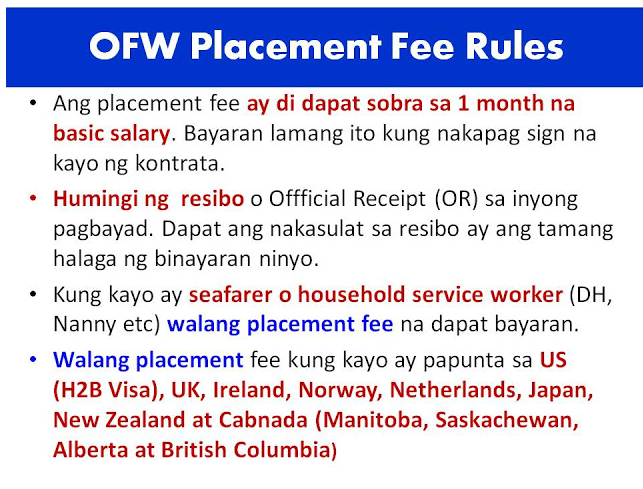
If you are applying for job as an OFW, it is very important to be aware of the fees associated with your job application to avoid illegal recruitment or scam. Be vigilant when you get text messages asking you to pay for reservation fees.  1. PLACEMENT FEE-  Some agencies  ask for placement fees more than what the law allows. Some don't, but if you are wondering how much it might cost:
If you are applying as household service worker, such as domestic helper, family driver, family cook, etc. You don't have to pay placement fee. 

Seafarers or seaman are also exempted from paying placement fees. 

There is a list of countries that exempts workers from paying placement fees. 
US (H2B Visa), UK, Ireland, Norway, Netherlands, Japan, New Zealand at Canada (Manitoba, Saskachewan, Alberta and British Columbia)


If you don't fall into the exempted category, your agency might collect or might not. If there is a placement fee that should be collected from you it should not exceed the 1 month equivalent of your basic salary. There are still agencies that hire OFWs for Middle East that does not require placement fee. 

Pay only the placement fee once you have signed the contract, and ask for official receipt (OR). 


It is also very important to have the appropriate visa for the job you are applying for. Never allow the agency or foreign employer to give a visa different from the job being offered to you. There are many cases of OFWs specially in the Middle East where OFWs are promised with  jobs in hospitals, hotels, or restaurant but they ended up working as domestic worker. The visa on your passport can also serve as your protection, and it will help you enjoy the benefits of your profession. There are list of professions that gives you chance to bring your family with you, and your profession will be based on what is on your visa. 

2. TRAINING FEE- Some jobs will require you to get training certificates if you don't have one. Training fees depend on how much the training centers charge, private training centers usually charge more. If you want to save on training fee, you can visit nearest TESDA center and check if they are providing the training and certifications you needed  before applying for job. Besides, even if you don't get hired overseas, you can still use the skills you earned and you can have certificate and credentials which you can use again next time you apply for job. 
3. DOCUMENTATION FEE- You will be required to submit documents like Police or Barangay Clearance, passport, NBI  and other documents needed to process your application. Here is a table provided by POEA to give you ideas on how much it will cost.


4. PROCESSING AND OTHER FEES- There are also other fees you which the agency might ask you to pay. Here is a table of fees that you should pay and those that your employer should pay. Remember, you don't have to pay for your plane ticket or visa, it is the responsibility of your employer. The Philhealth fee is also no longer mandatory for OFWs, however if an OFW has dependents in the Philippines we would suggest that you consider this for their benefit in case of hospitalization. 


Sunday, March 20, 2016

Speech of ALCADEV Graduate

Posted by Belarmino Davalos Saguing                                                                                                     Rome, Italy 20 March 2016

(source: unnamed author, copied from Facebook post by ALCADEV Lumad Caraga Region)


SPEECH OF ALCADEV GRADUATE:


Photo by Alcadev Lumad Caraga Region//Facebook 

Sa aming kagalang-galang na Gobernador/ Hon. Johnny T. Pimentel, Sa ating mayor ng Tandag na si Honorable Madame Roxanne C. Pimentel,/ at sa lahat ng mga opisyal ng Probinsya at local na pamahalaan,/ Sa relihiyosong grupo ng Katoliko Romano/ mga Madre/ at mga pari na pinangungunahan ng mahal at kagalang-galang na Obispo/ Monsignor Nerio P. Odchimar,/ Sa grupo ng Iglesia Filipina Independiente,/ mga pari at mga Obispo,/ Sa mga Pastor at Obispo din ng UCCP, /Sa lahat ng mga guro at estudyante ng iba’t ibang paaralan/ na sakop ng rehiyon ng CARAGA, / Sa mga membro at lideres ng MAPASU at iba pang organisasyon,/ Sa aming mga magulang,/ mga guro ng TRIFPSS at ALCADEV /na walang sawang nakikibahagi sa aming mga maliligaya at mapait na karanasan,/Sa lahat ng mga bisita/ at sa inyong lahat ng mga nandito ngayon, /ISANG MAALAB AT MAALIWALAS NA PAGBATI PARA SA INYONG LAHAT…/


Ngayon po na mga panahong ito/ ang masasabi namin na kaming mga katutubo ay nasa kaibuturan ng kahirapan. /
Ito ang pinakamabigat na yugto ng aming buhay o kasaysayan. /
Para sa amin/ ito’y walang katulad na bigat na halos kami po ay mawawalan na ng pag-asa sa buhay./ Ngunit dahil sa inyo,/ na nandito ngayon, /kayong dumadalaw sa amin at nagbibigay ng suportang moral,/ financial /at kung anumang mga bagay, /kayo ang bumubuhay sa pag-asa sa aming mga kaloob-looban…/
kaya salamat sa inyong lahat…/


Diko maikakaila/ at di ko Lubos maisip /kung paano ko babaybayin ang aking nararamdaman ngayon… /Di ko alam kung ako ba'y matutuwa sa aming naabot… /Di ko alam kung tama bang sabihin/ na kami’y natutuwa/ samantalang hindi nga kami nakatungtong sa stage ng aming paaralan sa Han-ayan…Paano ko sasabihin / na kami maging masaya sa araw na ito/ kung kahirapan ang bumabalot sa aming kalagayan, /kalagayang hindi namin nakasanayan, kalagayang kami pa ang nahihirapan at namatayan,/ ngunit kami pa ang nilalait/ ginagawan ng mga isyung walang katotohanan./


Paano kami matutuwa,/ kung ang buhay namin ay patuloy na nailalagay sa panganib/ at walang katiyakan. /Nariyan ang mapait na ala-ala ng aming mabait at maalalahaning direktor/ na si Tatay Emok Samarca, /ang aming mga mapagmasid at mababait na lider at datu/ Angkol Onel at Lolo Bello, /ang karumaldumal nilang karanasan sa kamay ng mga bandido/ na hanggang ngayon patuloy pang malaya,/ nagbabanta /at patuloy na bumabagabag sa amin. / Bakit? / bakit nila ito ginagawa sa mga mabubuting tao?/


Ngayon / umabot na kami sa 199 na araw/ dito mismo sa evacuation center sa Sports Complex ng Tandag City/


199 na araw na po/ mula ng lumisan kami sa aming nagisnang komunidad, 199 na araw na po/ na hindi parin nahuli/ o hinuli/ at napaparusahan ang mga taong gumawa sa karumaldumal na krimen,/199 na araw na po / na hindi parin binubuwag ang mga paramilitary bagkus ay sumasama pa rin sila sa mga operasyong militar, /Ika 199 na araw na po, / nandito parin kami sa isang lugar na hindi kaaya-aya, / hindi namin nagagawa ang mga gawaing pang-agrikultura /hindi na namin nasilayan ang maramihang pagtatanim /ng ibat-ibang klase ng mga gulay sa aming sakahan,/


Namimis na naming/ ang daan-daang kilong maaani/ tuwing harvest time sa aming mga pananim. /Namimis narin namin ang mga buildings /o ang aming dorms at classrooms /


Hindi ito mawawalay sa aming mga ala-ala dahil / ang bawat piraso ng mga bagay na inilagay/ at ginagamit para mabuo ang mga building na iyon /ay dumadaan sa mga bisig naming mga mag-aaral / at ng aming mga magulang…/Saksi ang aming mga pawis, / saksi ang aming mga kamay /sa mga paghihirap para mabuo ang kalsada papasok sa paaralan, /Saksi rin ang aming mga palad sa pagdala /at paghakot ng mga materyales, /mga semyento at hollow blocks,/ para sa aming paaralan…/Ngayon ang tanong ko,/ bakit ba ang ibang tao ang itinuturong dahilan ng pagkabuo ng paaralan?/ na samantalang kami,/ kaming mga estudyante, / ang aming mga guro/ at mga magulang ang siyang nasisikap para dito. /Bakit sinasabing sa NPA ang paaralan namin? ///


Bakit hindi kikilalanin ang paghihirap namin, /ang pagsisikap ng aming mga magulang at ng organisasyong MAPASU? /


Bakit pinapatay ang aming mga lider at guro?/ Alam naming ang kanilang pagkatao,/ hindi sila NPA,/ bakit sila pinatay?/ Hindi porke't anti-mining ang aming mga lider,/ mga magulang at guro/ mga NPA na sila.// Pinanghahawakan naming anti-mina kami…// dahil ito’y nakasaad sa aming TRADISYON at KULTURA./ 


Paulit-ulit naming sinasabi na,/ “Ang Pag-ibig namin kay MAGBABAYA,/ ay ang pag-ibig at pag-iingat sa mga magaganda niyang likha. /Ang Kalikasan.”/ Ang Mina ay sumisira at sisira sa kalikasan /kaya hindi kami pumapayag na miminahin ang aming lupang Minana./


Naniniwala kaming,/ Ito ang dahilan kung bakit sila pinatay, / ito ang dahilan kung bakit ginagawan sila ng mga gawagawang kaso,/ ito ang dahilan kung bakit sinasabi nilang supporter kami ng NPA,/ ito ang dahilan kung bakit binabato kami ng napakaraming mga panghuhusga /at mga paninira. /Dahil gusto nilang makapasok ang mina sa aming lupang Minana. / Hindi ba halata?/ May nakaabang nang dambuhalang makinarya ng ABACUS Mining.


Sinisira nila ang aming dignidad bilang katutubo/ ang aming buhay,/ang aming kinabukasan, / matupad lamang ang kanilang makasariling interes, /kasakiman sa kapangyarihan at kasakiman sa kayamanan.


Sa huli,/ sasabihin ko/ kung sanay namumuhay lamang tayo ng simple, / hindi na sana kailangan pang gastahin ang kalikasan para sa pag-unlad./ Maari nating mapalago ang ating bayan ng hindi natin sisirain ang ating inang kalikasan.


Maraming salamat Po…!/

###


What is the Truth about the OWWA Funds?


Posted by Belarmino Dabalos Saguing
Rome, Italy, 20 March 2016


(source : note by Jester-in-exile, Aug. 1, 2006 in reply to the article  Truth about OWWA funds August01, 2006Posted in: Congress WatchGovernanceIn the NewsMigrant Workers Issues )


OWWA was established to protect and promote OFWs’ welfare, that much is obvious. It’s even supposed to be part of the budget:


Table from the Article Truth about OWWA funds August01, 2006Posted in: Congress WatchGovernanceIn the NewsMigrant Workers Issues


OWWA was established to protect and promote OFWs’ welfare, that much is obvious. It’s even supposed to be part of the budget:


If OWWA funds are inviting much scrutiny regarding the availability of money for the evacuation of OFWs, it is because under Republic Act No. 8042, or the Migrant Workers and Overseas Filipinos Act of 1995, the agency is mandated to administer, among others, an Emergency Repatriation Fund (ERF) to evacuate overseas workers in case of emergencies such as war, epidemic, disaster or calamities (natural or man-made).


A seed amount of P100 million was set aside for this purpose from the funds managed by OWWA, afterwhich Congress is supposed to allocate no less than P100 million for the ERF in the annual national budget.


Of course, the esteemed members of the House of Reprehensibles didn’t think it was necessary to spend money to protect and promote OFW welfare:
But Congress has failed to allocate a single centavo to the fund over the years.


Instead:
“Since there is no other source, presumably, the ERF gets a share from the $25 charged as fees by OWWA for every contract of OFWs,” says laywer Berteni Causing, who finds the law vague as to where the fund will be sourced.


“With about 3,000 workers leaving abroad every day, even at $1, you could just imagine how much money they are getting in a year,” he says.


OWWA places its average collection from OFWs between P800 million and P1 billion a year — though overseas workers are contesting why they get to be charged the $25 contribution when the law stipulates that “in no way shall the fees be charged or collected from the worker.”


What happens is that OFWs shell out from their hard-earned wages money to make sure that their welfare will be protected. to put it in another way, OFWs are paying OWWA “protection money.”


Now it wouldn’t be so bad, perhaps, if the money the government extorts from OFWs would be for the benefit of OFWs. 

(Each OFW is required to pay USD$25 as membership contributions per contract to replenish OWWA’s welfare fund. OWWA funds are reported to have reached Php18 billion from OFW contributions alone.)


Instead:
But the biggest reason for the apprehension about the OWWA funds’ status, particularly among OFWs, considering the obvious huge amounts of money involved, is that the said funds had been the subject of a number of questionable transactions in the past.


Especially favorable was OWWA to this questionable occupant of MalacaƱang, Her Royal Asininess Gorya Magarapal-Arrovo, Queen of the Enshanted Kingdom, Defender of Garshi, Freshident, Cheat Ekshecutive, and Grand Kleptocrat of the world’s biggest trapocracy:


OFW groups have also denounced the alleged gross misuse and plunder of OWWA funds in relation to Gloria Macapagal-Arroyo’s candidacy in the 2004 elections involving the transfer of the P530-million Medicare Fund for OFWs to the Philippine Health Corp. (PhilHealth) and $87,757 (then P23.587 million) rechanneled to the International Labor Affairs Service of the Department of Labor and Employment….
In his memorandum to Arroyo, (Francisco Duque III, then PhilHealth president) said “the proposed transfer will have a significant bearing on the 2004 elections.” Three months later in February 2003, Arroyo signed the proposed executive order.


The money enabled Arroyo to give away Philhealth cards valid for a year to people in the places she visited during the campaign. OWWA, by that time, had already been turning down health claims of hundreds of overseas workers and eventually stopped all medical reimbursements in a meeting on January 16, 2004.


Not only did OWWA steal for HRA GMA, but OFWs were screwed even more; the administration wouldn’t give damn if any one of them fell ill — let alone dead.


To the OFWs who bear the burden of the country’s economy on their backs, keeping us afloat with wages earned with their blood and sweat, a suggestion:


For as long as OWWA and the government keep on shafting you, GIVE THE GOVERNMENT THE FINGER. REFUSE TO PAY PROTECTION MONEY TO OWWA.


Tuesday, February 16, 2016

FILIPINO WORKERS IN HAWAII AND THE WEST COAST, 1906-1935

Posted by Belarmino Dabalos Saguing                                                                                            Rome, Italy  16.02.2016

 How it started


A chance encounter in 1901 between a trustee of the Hawaiian Sugar Planters Association (HSPA) and a band of Filipino musicians en route to the United States led the planter to speculate about Filipinos as potential plantation workers, for he felt that these musicians had a "healthy physique and robust appearance." Even before 1907, Hawaii had begun looking for other pools of unskilled labor on the island of Luzon. During 1907 some 150 workers were sent to Hawaii. Two years later, with Chinese, Japanese, and Koreans now banned from immigrating to the United Sates, the HSPA returned to the Philippines, looking for workers. The Bureau of Census reported that there were 2,361 Filipinos in Hawaii in 1910. Recruiting efforts after 1909 centered on the Visayan Islands, Cebu in particular, and Luzon's Tagalogs.


In 1915 recruiters focused on Luzon's northwestern Ilocano provinces: Ilocos Norte, Ilocos Sur, and La Union. Immigrants from Pangasinan, Zambales, and Cagayan account for about 25 percent of those from Ilocano. The Ilocanos, suffering greatly from economic hardship and overpopulation, proved willing recruits. The HSPA awarded a three-year labor contract to Filipinos migrating to Hawaii; this paid their passage to Hawaii and guaranteed free subsistence and clothing. If they worked a total of 720 days, they received return passage money. A worker was not penalized for violating his contract, but if he did, he forfeited all guarantees, including his return passage. Plantation owners found the Ilocanos to be the "best workers," and poverty in their provinces provided a stimulant for out-migration. By 1935, young single Ilocano men were the largest Filipino ethnic group in Hawaii.


According to census figures, the Filipino population in Hawaii climbed from 21,031 in 1920 to 63,052 in 1930, but dropped to 52,659 by 1940. The decline in the number of Filipinos during the late 1930s is attributable to the return of many to the Philippines during the Depression years and to others seeking greener pastures on the West Coast. The high point of immigration to Hawaii occurred in 1925, when 11,621 Filipinos arrived in Honolulu. At that point, the HSPA closed active recruiting in the Philippines, relying upon self-motivation to maintain the influx of workers.


In 1910, only 406 Filipinos lived on the United States mainland. The largest group, of 109, lived in New Orleans, the remnants of a nineteenth-century settlement of Filipino sailors who came ashore at that port city, married local women, and found jobs. The state of Washington had 17 and California had only five. In 1920, 5,603 Filipinos lived along the West Coast or in Alaska. California then had 2,674 Filipinos while Washington had 958. The northeastern United States had the second-largest number: 1,844.


The 1920s saw dramatic changes as California's Filipino population, mostly single young men, increased by 91 percent; over 31,000 Filipinos disembarked at the ports of San Francisco and Los Angeles. In 1930, there were 108,260 Filipinos in the United States and the Territory of Hawaii. California had 30,470, and this number rose to 31,408 by 1940. Washington had 3,480 in 1930 and 2,222 in 1940. Apart from the West Coast and Hawaii, the next largest concentration was in New York, which in 1930 had 1,982 and 2,978 in 1940. Many of these Filipinos experienced significant racial discrimination.


POSTWAR IMMIGRATION

Emigrants in the second wave left the Philippines in increasing numbers during the late 1940s and 1950s. This group included war brides, the "1946 boys," and military recruits. War brides were the spouses of American GIs who married Filipina women while being stationed in the Philippines. After the passage of the War Brides Act of 1946, it is estimated that 5,000 brides came to the United States. Contracted workers called the "1946 boys", or Sakadas, numbered 7,000 were a major component of the second wave. They were the last large group of agricultural laborers brought to Hawaii by the sugar planters. Plantation owners brought them in an effort to break up the first interracial and territorial-wide strike organized by the International Longshoremen and Warehousemen's Union (ILWU). The Philippine workers supported the ILWU strike, which resulted in the first major victory for Hawaii agricultural workers. Filipinos who came to the United States through the U.S. military were another component of the second wave. A provision of the 1947 US-RP Military Bases Agreement allowed the Navy to recruit Filipino men for its mess halls. During the same year President Truman ended racial segregation in the military and the Filipino replaced African Americans in mess halls. By the 1970s, more than 20,000 Filipinos had entered the United States through the U.S. Navy.


Internal conditions in the new republic contributed to many moving from the islands to the United States. By 1960 Hawaii, which had become a state a year earlier, had 69,070 Filipinos, followed closely by California with 65,459. The two states together accounted for 76 percent of all Filipinos living in the United States. The Pacific Coast states had 146,340 (83 percent of the total), while the East and the South had slightly more than 10,000 each and the Great Lakes states had 8,600. Included in these census numbers were second-generation Filipino Americans.


Changes in American immigration law in 1965 significantly altered the type and number of immigrants coming to the United States. Unlike pre-war immigrants who largely worked as unskilled laborers in West Coast and Hawaiian agriculture and in Alaska's salmon canneries, the third wave was composed of larger numbers of well-educated Filipinos between the ages of 20 and 40 who came looking for better career opportunities than they could find in the Philippines. This highly skilled third-wave population had a command of the English language, allowing them to enter a wide range of professions.


Unlike earlier arrivals, most of the Filipino immigrants after 1970 came to the United States without intending to return to the Philippines. In 1970, 343,060 Filipinos lived in the United States; in 1980, the number was 781,894, with 92 percent of these living in urban areas. By 1990, the number of Filipinos had reached 1,450,512. The West, as reported in the 1990 Census, had 991,572, or 68.4 percent of the Filipinos. The other three areas, Northeast, Midwest, and South, ranged from 8.8 to 12.5 percent. California in 1990 had the largest Filipino population, almost 50 percent of the total; Hawaii had fallen to second place. Every state in the union had a Filipino population. Florida, Illinois, New York, New Jersey, Texas, and Washington had Filipino populations in excess of 30,000.


Acculturation and Assimilation

From the outset of their arrival in Hawaii and the Pacific Coast, Filipinos, as a color-visible minority, encountered prejudice and discrimination as they pursued their economic and educational goals. One major problem for Filipinos prior to 1946 was the issue of American citizenship.
From 1898 to 1946, Filipinos, classified as American nationals, could travel abroad with an American passport and could enter and leave the United States at will, until the Tydings-McDuffie Act limited the number entering as immigrants to 50 a year. The opportunity for most Filipinos to become American citizens before 1946 was closed to them by the United States Supreme Court in its 1925 decision, Toyota v. United States. This decision declared that only whites or persons of African descent were entitled to citizenship, thus closing the opportunity for Filipinos to become United States citizens. Those Filipinos, however, who had enlisted and served three years in the United States Navy, Marine Corps, or Naval Auxiliary Service during World War I and who had received an honorable discharge could apply for citizenship. In 1946, Congress passed a law that permitted Filipinos to qualify for American citizenship.


The inability to acquire citizenship, besides being a social stigma, presented serious economic and political implications. Since most states required citizenship to practice law, medicine, and other licensed professions and occupations, Filipinos were prohibited from these occupations. Filipinos had no recognized voice of protest to speak for them, unlike immigrants from other countries who had ambassadors and consuls to support them. The Philippines had a Resident Commissioner in Washington who could protest, but this commissioner generally proved ineffective in dealing with federal and state bureaucracies.


Throughout the Depression years of the 1930s, Filipinos found it difficult to qualify for federal relief. Although the Works Progress Administration in 1937 ruled that Filipinos were eligible for employment on WPA projects, they could not receive preference since they were not citizens. During the 1920s and 1930s, those Filipinos living on the Pacific Coast encountered prejudice and hostilities resulting in hateful discrimination and race riots. A sagging economy made assimilation difficult if not impossible.


At the height of discrimination in California, the California Department of Industrial Relations published in 1930 a biased study, Facts about Filipino Immigration into California, claiming that Filipinos posed economic and social threats. On the West Coast, Filipinos were frequently denied service in restaurants and barbershops and were barred from swimming pools, movies, and tennis courts. They found that their dark skin and imperfect English marked them, in the eyes of whites, as being different and therefore inferior. White Californians presented several contradictions that confused Filipinos. Farmers and certain urban enterprises welcomed them because they provided cheap labor. However, discriminatory attitudes relegated them to low-paying jobs and an inferior social existence. Consequently, many other Californians criticized the Filipinos' substandard living conditions and attacked them for creating health problems and lowering the American standard of living. Faced with discrimination in real estate, Filipinos were forced into "Little Manilas" in California cities. Filipinos in cities such as Chicago, New York, and Washington, D.C., also clustered together.


Discrimination against Filipinos has persisted into the late twentieth century, but civil rights legislation, affirmative action, and equal opportunity laws have improved the daily lives of most Filipinos who have arrived in recent decades. A perhaps unexpected form of discrimination for immigrants arriving after 1965 was the hostility that they met from second-generation Filipinos who saw the new arrivals as snobs and upstarts who were benefitting from advances made by the older group. At the same time, more recent Filipino immigrants have treated their older compatriots with disdain, considering them the equivalent of "hillbillies."


During the 1990 Census, Filipinos reported a median income of $46,698, while the median income for the entire United States was $35,225. This can be attributed to the ongoing stream of highly educated and highly skilled Filipinos from the Philippines and to second and third generation Filipino Americans finishing college.